



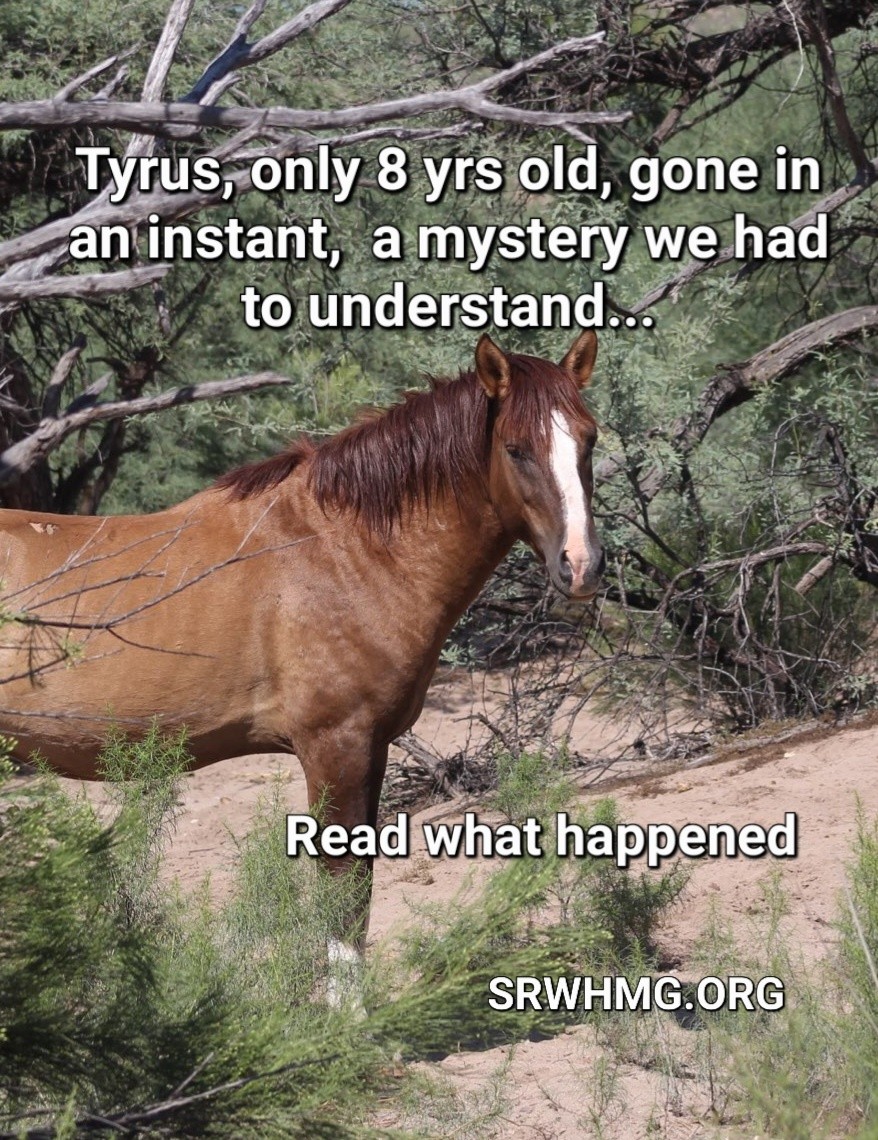
⚠️How a Salt River Wild Horse Suddenly Dropped Dead
During the VSV outbreak — and at a time when EHV-1 was also discovered in Arizona — two wild stallions died along the Salt River on the same day: Red Wind and Tyrus. Finding two horses dead on the same day was shocking and mysterious.
⁉️ Tyrus, a healthy 8 year old bachelor stallion, was found in a wash, halfway against a bush, as if he had collapsed in an instant. There were no visible injuries. With viruses actively circulating — and knowing that Salt River wild horses have also been shot in the past — we felt it was critical to find out exactly what happened.
Red Wind, meanwhile, was found across the river, he had laid down in fresh grasses to take his last breath. While heartbreaking, his death was consistent with his very old age. We collected samples for testing and left his body so it could return to nature, like his ancestors have done for centuries.
Arranging a necropsy for a wild horse is not easy. It required careful transport, veterinary coordination, funds, and also patience, as results can take up to six weeks. While costly, we knew this was something we had to do. Tyrus deserved answers.⚖️
We now finally have closure.
️ The necropsy revealed that Tyrus died from a ruptured spleen. While he did test positive for VSV, that was not the cause of death. The spleen is highly vascular, and when it ruptures, death can occur within seconds. Knowing this brought some comfort, as it means he did not suffer long.
A ruptured spleen requires significant impact. The most likely cause was an unfortunate, high-impact kick — consistent with what we observed in the days before his death. Tyrus had been actively battling many other stallions, trying to win a mare, as strong and matured bachelor stallions do.
We are often asked whether stallions fight to the death. The answer has always been no. Years of hands-on observation show us that battle injuries do happen — bite marks, swelling, limping and even fractures are not uncommon. What we have not seen before is instant death. But this case shows that, in rare circumstances, it can happen. Perhaps this even makes us rethink a few older mysterious deaths, like Dirk for example, and Gandalph.
We cannot always afford necropsies on every horse of course, but in this case it mattered. We wanted facts, not speculation. The total cost, including transport was $2,180 for both Red Wind’s tests and Tyrus. We posted the receipts in the comments. (That does not include any gas money for volunteers, or pay for our SRWHMG veterinarian, or hotline operator)
While we believe it was worth every dollar to understand what happened, we now need help covering this extra expense.
If you are able to help us recoup the cost, every contribution directly supports our ability to respond quickly, investigate and continue giving you scientific information about Salt River wild horses.
- Donate via PayPal: [email protected]
- note “Necropsy fund”
- Donate via Zelle: 6023963978
- Or Venmo: [email protected]
- Or mail:
- SRWHMG
PO Box 64264
Phoenix, AZ, 85082- note “Necropsy fund”
- SRWHMG
We are comforted by the fact that both Tyrus and Red Wind died the same way they were born, wild and !
Thank you for reading, for sharing, and for standing with these wild horses! Every comment, every share, every dollar helps!
SRWHMG.
P.S. If you happen to see people sharing our information acting as if it is theirs, please tell them to be a decent human and give us a little credit for the hard work, thank you.